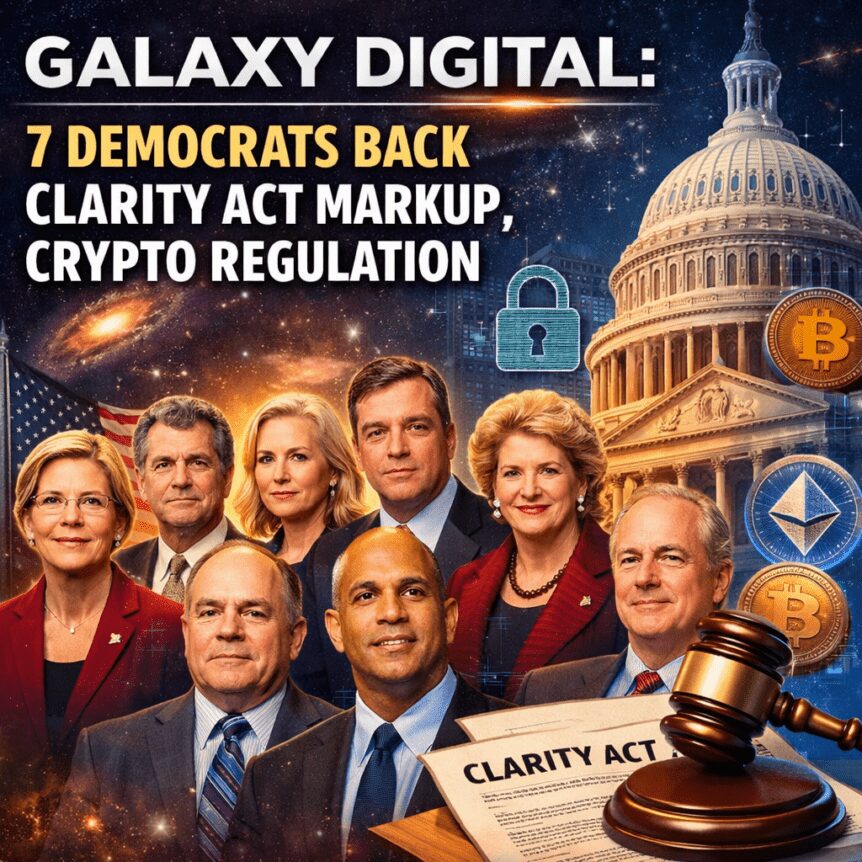
The Digital Asset Market Clarity Act (CLARITY Act) faces a pivotal juncture as a markup vote approaches in the U.S. Senate. Galaxy Digital, a crypto investment firm, argues that seven Democrats on the Senate Banking Committee could be decisive in clearing the bill for passage, signaling a potential shift in the long-running effort to establish a federal framework for crypto activities. The firm’s analysis, shared via a post on X, assigns Ruben Gallego and Angela Alsobrooks as constructive/pro-framework voices, with four other lawmakers positioned as deal-makers and one categorized as mixed. If a sufficient bloc of Democrats votes in favor at markup, Galaxy Digital contends the likelihood of eventual Senate passage rises meaningfully.
In its assessment, Galaxy Digital highlights certain Democrats as more amenable to the framework and notes that others remain cautious or resistant. The firm specifically identifies Mark Warner, Catherine Cortez Masto, Andy Kim and Raphael Warnock as “deal-maker/conditional,” indicating support contingent on assurances around stronger safeguards against illicit finance and money laundering risks. Lisa Blunt Rochester is labeled “mixed,” suggesting potential swing voting behavior. The analysis underscores that any path forward hinges on a broader coalition within the chamber.
Passing the CLARITY Act would, in theory, yield clearer federal rules for the U.S. crypto industry, potentially reducing years of regulatory uncertainty and encouraging more projects to establish operations domestically. The move is widely viewed as a means to harmonize oversight across agencies and provide a comprehensive statutory baseline for cryptoassets, exchange activities, and related financial instruments. According to Cointelegraph, the policy conversation remains deeply entwined with concerns about consumer protections, anti-money laundering (AML) measures, and the treatment of stablecoins and decentralized finance in a regulated regime.
The markup outlook has been complicated by shifting political dynamics and past hesitations among lawmakers. The CLARITY Act was introduced in July 2025 but stalled in January after Coinbase withdrew its support, citing concerns over protections for open-source software developers, a prohibition on stablecoin yields, and broader DeFi regulation gaps. The latest timing places the bill on track for consideration by the committee this week, with the prospect of a broader Senate debate and potential amendments before any floor vote. The committee’s 24 members—comprising 13 Republicans and 11 Democrats—must approve the measure by a simple majority to advance it to the Senate floor.
Key takeaways
- The CLARITY Act is nearing a Senate Banking Committee markup, with Galaxy Digital identifying seven Democratic lawmakers as pivotal to advancing the bill.
- Democratic positions vary, with several labeled as deal-makers or mixed; a solid cross-party coalition will be required to reach a floor vote.
- Past developments include Coinbase withdrawing support in January over concerns related to open-source software protections, stablecoin yields, and DeFi regulation — a factor shaping current expectations.
- Industry and policy signals indicate that achieving a 60-vote threshold in the Senate will require notable bipartisan alignment and robust AML/KYC safeguards.
Political dynamics shaping CLARITY Act markup
The upcoming markup is framed as a test of whether a core group of Democrats can align with like-minded Republicans to push a comprehensive crypto-regulatory framework through the Senate. Galaxy Digital’s brief, which emphasizes the “deal-maker” and “mixed” classifications among committee members, reflects the nuanced vote calculus that characterizes current U.S. policy debates on digital assets. Notably, the classification of seven Democrats as key to moving the bill suggests that individual votes and cross-party negotiations may determine whether the bill moves beyond committee stage.
Among the lawmakers highlighted by Galaxy Digital, Mark Warner, Catherine Cortez Masto, Andy Kim and Raphael Warnock are described as “deal-maker/conditional.” That labeling implies a readiness to support the framework if certain protections and regulatory guardrails are satisfied. Lisa Blunt Rochester is identified as “mixed,” potentially serving as a swing vote depending on the committee’s framing of enforcement, innovation incentives, and consumer protections. The dynamics among these members will influence the committee’s overall stance and the likelihood of advancing the bill on Thursday.
According to Stand With Crypto, a platform that tracks lawmakers’ crypto positions, Warner, Cortez Masto and Alsobrooks are considered strongly supportive of crypto policy, while Kim is viewed as neutral. Reed, Warren, and Smith are ranked as strongly opposed to crypto policy, with other committee members lacking sufficient data to determine a stance. These rankings illustrate the spectrum of positions that lawmakers bring to the markup and the potential friction points that could hinder broad-based support.
Regulatory context and policy implications
The CLARITY Act seeks to establish a clear federal framework governing the classification and treatment of digital assets, with implications for exchanges, issuers, investors, and financial institutions. A central objective is to reduce ambiguity that has historically fed regulatory uncertainty and dispersed state-level approaches. The bill’s passage would interact with other regulatory considerations, including existing guidance from the Securities and Exchange Commission (SEC), the Commodity Futures Trading Commission (CFTC), the Department of Justice (DOJ), and the Financial Crimes Enforcement Network (FinCEN). It would also influence how stablecoins are integrated into banking relationships and payment systems, an issue that has drawn scrutiny from policymakers and regulators alike.
In this policy ecosystem, the CLARITY Act’s alignment with AML/KYC standards and its approach to licensing and regulatory oversight carry practical consequences for crypto firms, exchanges, and traditional financial institutions seeking to provide on-ramps and custody services. If enacted, the Act could shape ongoing cross-border regulatory alignment, particularly in relation to the European Union’s MiCA framework and other international regimes, as firms evaluate whether a U.S. market presence aligns with global compliance requirements.
Notably, the Act’s proponents have stressed the importance of stronger safeguards against illicit finance, consistent with broader regulatory reform objectives. The bill’s proponents and industry observers alike will be watching how provisions around open-source software protections, user data, and governance of decentralized products are addressed in committee discussions and potential amendments. The balance between fostering innovation and ensuring robust risk controls remains a central theme of the regulatory conversation.
Industry responses and compliance implications
Industry voices have emphasized the need for a stable, predictable regulatory environment that can support responsible innovation while imposing necessary safeguards. Coinbase’s position, as articulated by Kara Calvert, the company’s vice president of US policy, has framed the markup as a test of the bill’s feasibility within the Senate. Calvert indicated that passage may require a minimum threshold of bipartisan votes, highlighting the practical reality that broad-based support is essential for enacting legislation with wide-reaching implications for the crypto sector. This viewpoint aligns with the broader industry emphasis on legal protections for developers, transparent governance, and a clear path to licensing and supervision for crypto businesses.
From a compliance perspective, the CLARITY Act would interact with existing AML/KYC obligations, anti-fraud provisions, and cross-border enforcement frameworks. As lawmakers weigh the bill, institutions will consider how any federal standard would interact with ongoing supervisory expectations, including reporting requirements, transaction monitoring, and risk-based compliance programs. The potential for a unified federal standard could reduce fragmentation across states and regulatory agencies, potentially simplifying governance for multinational firms while increasing scrutiny in areas related to consumer protection and market integrity.
Market participants and policymakers will also be attentive to the stalled January episode, when Coinbase withdrew support due to concerns about protections for open-source software developers and the treatment of stablecoins and DeFi. The reversal of previous support underscores the ongoing tradeoffs between innovation incentives and risk controls that any comprehensive regulatory framework must navigate. As markup approaches, stakeholders will be assessing whether the Act addresses those concerns in a manner that satisfies both the industry’s operational needs and regulators’ risk-mitigation priorities.
Historical backdrop and current status
The CLARITY Act, introduced in mid-2025, has been the subject of intense policy debate. Its trajectory stalled in January following Coinbase’s withdrawal of support, a development that reflected deeper concerns about the balance of protections for developers, stablecoin regulation, and the scope of DeFi governance within a federal framework. With Thursday’s markup on the horizon, proponents seek to establish a pathway to full Senate consideration and a potential floor vote, while opponents stress the need for further refinements to ensure a robust, enforceable regime.
Industry observers, including policy professionals and advocacy groups, have underscored that successful passage will depend on securing bipartisan backing and addressing open questions about open-source software protections, stablecoin yields, and decentralized finance regulation. As the bill moves through committee, attention will focus on amendments that clarify these areas and on how the proposed framework interfaces with existing regulatory authorities and enforcement priorities.
For context, observers have noted that the regulatory discourse around crypto in the United States remains closely tied to broader policy objectives, including consumer protection, financial stability, and the integrity of the financial system. The CLARITY Act represents an attempt to codify a unified approach to digital assets, with potential ripple effects across licensing, banking partnerships, and cross-border activity. Industry participants, lawmakers, and compliance professionals will closely monitor how markup outcomes influence the broader regulatory landscape in the near term.
Closing perspective
As the CLARITY Act advances toward markup, the central question is whether a coalition sufficiently broad to secure a Senate floor vote can emerge. The coming days will reveal how lawmakers balance innovation incentives with risk controls, and how the bill’s provisions align with ongoing regulatory priorities both domestically and in the global policy environment. In the near term, institutions should prepare for potential shifts in the regulatory baseline that could affect licensing requirements, supervisory expectations, and compliance workflows across the crypto sector.