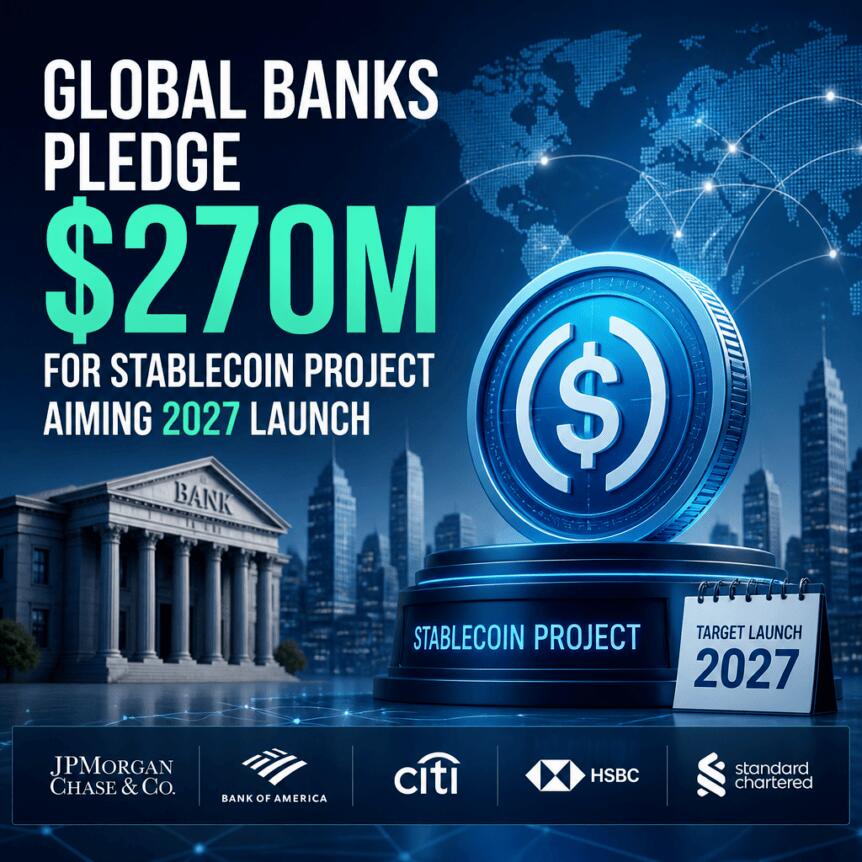
A consortium of 21 financial institutions has committed roughly $270 million to support a new stablecoin venture called Project Faro, according to Bloomberg. The bank-backed initiative is designed to operate for about five years and to launch a US dollar stablecoin in the first half of 2027, with additional euro-denominated issuance planned afterward.
Bloomberg reports that the funding is intended to cover operational costs through the project’s early years. The initiative aims to issue stablecoins pegged not only to the US dollar, but to the currencies of all G7 countries, with the euro coin expected to follow the dollar launch.
Key takeaways
- Project Faro has secured about $270 million from 21 institutions, with Bloomberg framing it as financing for roughly five years of operations.
- The plan is to launch a US dollar stablecoin in the first half of 2027, followed by a euro-backed coin.
- Several member banks are also involved in other stablecoin efforts, including Open USD and Qivalis, reflecting a “multiple tracks” strategy.
- Faro is entering a market dominated by USDT (Tether) and USDC (Circle), but the consortium’s distribution channels could be a differentiator.
What Project Faro is building
Project Faro was first announced in September, but public detail has been limited. Bloomberg reports that the initiative is expected to be incorporated in the United States. While the precise operating structure has not been fully laid out, the broad target is clear: create a stablecoin issuance platform that can support multiple G7 currency pegs.
Among the banks named as participants are Citigroup, Goldman Sachs, Banco Santander, Deutsche Bank and BBVA, reflecting the initiative’s emphasis on mainstream financial infrastructure rather than crypto-native distribution models.
Banks are hedging across competing stablecoin projects
A notable feature of the Faro lineup is how many institutions are also involved in other stablecoin initiatives. BBVA, for example, is reported to be connected to multiple efforts, including Open USD and Qivalis. Rabobank is listed as a Faro member as well and previously joined Qivalis in May, when Qivalis said it expanded by adding 25 new banks to reach 37 total members.
Qivalis has also made regulatory progress. The consortium received authorization from the Dutch central bank as an electronic money institution in October 2026. Its stated objective is a fully regulated, euro-denominated stablecoin aimed at payments, cross-border settlements and tokenized asset transactions.
That overlap underscores a key strategic reality for traditional finance: rather than committing exclusively to one issuance roadmap, banks appear to be building parallel relationships, governance structures, and distribution pathways across multiple digital-currency ecosystems. The upside for participants is optionality—while the projects compete, they also allow banks to test different approaches to regulation, issuance mechanics and rollout.
A crowded stablecoin market—and a potential distribution edge
Even with significant institutional backing, Project Faro is stepping into a stablecoin economy already dominated by two crypto-native issuers. DefiLlama data cited in the report puts the stablecoin market at roughly $290 billion as of Nov. 10, with Tether’s USDT and Circle’s USDC together accounting for about 85% of the total.
According to DefiLlama, USDT had a market capitalization of approximately $176.3 billion, while USDC was around $70.4 billion. This concentration means new entrants face a steep challenge: they must persuade users and counterparties to adopt another token type and ensure sufficient liquidity and credibility to support payment and settlement workflows.
Still, the bank consortium may see a different route to competitiveness. The participating institutions already have banking customers, payment relationships and commercial ties that could help them distribute a stablecoin without starting from scratch. The report suggests Faro could leverage existing networks to reach both business users and potentially retail audiences.
That distribution logic also aligns with Open USD, a stablecoin infrastructure effort developed by the Open Standard consortium, which includes major financial and payments stakeholders such as Visa among founding partners. Like Faro, Open USD is pursuing an ecosystem approach—bringing together banks, payment providers, financial technology companies and merchants around shared stablecoin infrastructure rather than attempting to build a standalone adoption story.
The underlying challenge for both bank-backed initiatives is similar: translating traditional finance’s distribution and compliance capabilities into a compelling onchain payments and settlement experience that can compete with established issuers’ liquidity and network effects.
Why this matters for investors and builders
Project Faro’s funding and stated timeline suggest that large institutions are treating stablecoins as more than a research exercise. If the first dollar launch proceeds in the first half of 2027 as planned, it would provide a real test of whether regulated, bank-led issuance can achieve meaningful scale in a market that already has strong incumbents.
At the same time, the overlap between Faro, Open USD and Qivalis highlights a broader industry pattern: institutions are likely to hedge across multiple regulatory and distribution models while waiting to see which networks attract the most adoption. For participants in payments, treasury management, and tokenized finance, the key question is whether these parallel efforts converge on interoperable liquidity and practical payment rails—or fragment into competing ecosystems.
Readers should watch for clearer details on Faro’s incorporation, regulatory approach, and the specific distribution partners and network integrations that will support its 2027 dollar launch, alongside further progress from euro-focused initiatives like Qivalis.