Dubai stages a decentralized citywide blockchain week
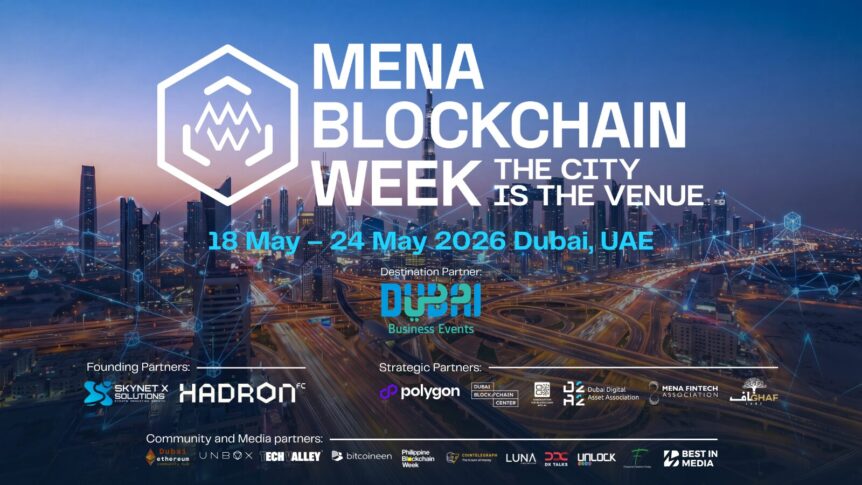
Dubai will host MENA Blockchain Week from May 18 to May 24, 2026, a coordinated, citywide set of blockchain events billed as the region’s first decentralized festival for the technology. Organisers expect more than 40 simultaneous events, over 5,000 attendees and in excess of 100 speakers, bringing together industry players, investors, policymakers and community groups across multiple venues.
The initiative is organised by SkyNet X Solutions with Dubai Business Events, part of the Dubai Department of Economy and Tourism, as official destination partner. Rather than consolidating programming inside a single conference centre, the week adopts a distributed structure that lets independent organisers run themed sessions, meetups and workshops across the emirate under a shared campaign identity.
How the citywide model is structured
MENA Blockchain Week operates on a layered model intended to separate campaign infrastructure, organisers, institutional partners and the audience. At the base, the lead organiser provides legal, branding and sponsor coordination. Above that, organisers and community leaders keep editorial control of their events. A third layer involves institutional partners including government entities, industry associations and exchanges. The final layer is the attendees: founders, developers, investors and public-sector representatives who will move between venues during the week.
Venues and partners named in organiser materials include Hadron Founders Club, Unbox Community, 25hours Hotel Dubai One Central and Dubai Founders HQ. Institutional supporters cited include Dubai Business Events, the Dubai Blockchain Center and the UAE Blockchain and AI Association, among others.
Programming and themes
The week spans eight thematic days, covering areas commonly discussed in industry agendas: community resilience and builders, AI in blockchain, payments and stablecoins, regulation and compliance, tokenisation of real-world assets, content creator economies, and trading and exchanges. The programme design signals an attempt to map the full spectrum of Web3 activity rather than focus narrowly on any single vertical.
Speakers and industry participation
Organisers say the week will feature representatives from major exchanges, regulators and platforms, including Binance and CoinMarketCap, VARA (the UAE’s virtual assets regulator), the Ethereum Foundation, Mintlayer and several regional exchanges and fintech firms. The mix reflects both global and regional ecosystem players, from infrastructure projects and cybersecurity firms to banks and venture accelerators.
Context: why Dubai is doubling down on blockchain events
Dubai has been cultivating a reputation as a global blockchain hub through targeted regulation, institutional promotion and commercial incentives. The Virtual Assets Regulatory Authority has been a visible part of that push, while government agencies and business promotion bodies have sought to attract talent and capital to the emirate. The decentralised event model aligns with a recent trend to lower barriers for community-led initiatives while retaining city-level branding and logistics support.
Organisers present MENA Blockchain Week as a community-driven response to fluctuating market conditions — a way for the ecosystem to generate momentum without depending on a single flagship conference. That approach also spreads the economic benefits of an event week across multiple venues and service providers, a potential advantage for local stakeholders.
Implications for the industry and investors
There are several practical implications for stakeholders. For investors and international attendees, the event offers concentrated access to startups, founders and policymakers within a short time window. For projects, participating in a coordinated, citywide campaign can increase visibility without the costs of mounting a standalone conference.
At the same time, decentralised programming raises quality-control and coordination questions. With many independent organisers operating under a shared banner, signal-to-noise may vary across sessions, complicating efforts by attendees to prioritise high-value meetings. For sponsors and institutional partners, ensuring consistent standards of compliance, security and speaker vetting will be important, especially given increased regulatory scrutiny in many jurisdictions.
Potential challenges and regulatory considerations
While Dubai’s regulatory and promotional framework helps legitimise large-scale blockchain activity, risks remain. Decentralised events can create gaps in compliance oversight if responsibilities are not clearly assigned. The presence of global exchanges and platforms will draw regulatory attention, and organisers will need to coordinate with VARA and other authorities around topics such as stablecoins, tokenisation and cross-border payments.
Operationally, attendees and companies will also face scheduling complexity as events run in parallel across the city. The success of the model will depend on effective information flows, reliable partner coordination and clear messaging from organisers and institutional backers.
Outlook
MENA Blockchain Week is an experiment in distributed event infrastructure that mirrors broader shifts in how the blockchain community organises: more grassroots, more modular, and less dependent on a single convening. If it succeeds, the format could become a template for other regional ecosystems seeking to combine community autonomy with city-level promotion. If it falls short on coordination or quality control, it will underline the trade-offs involved in decentralised programming.
Either way, the week represents a concentrated opportunity to gauge Dubai’s evolving role in the global blockchain landscape, and to observe how government, industry and communities collaborate to shape the sector’s next phase.
Details: MENA Blockchain Week runs May 18-24, 2026, across multiple venues in Dubai.