What Is Quantum Computing
Quantum computing has made rapid strides over the past year, quickly transitioning from the Noisy Intermediate Scale Quantum (NISQ) phase to fault-tolerant, logical qubits. The industry has seen several key breakthroughs, with experts predicting its use in niche industries.
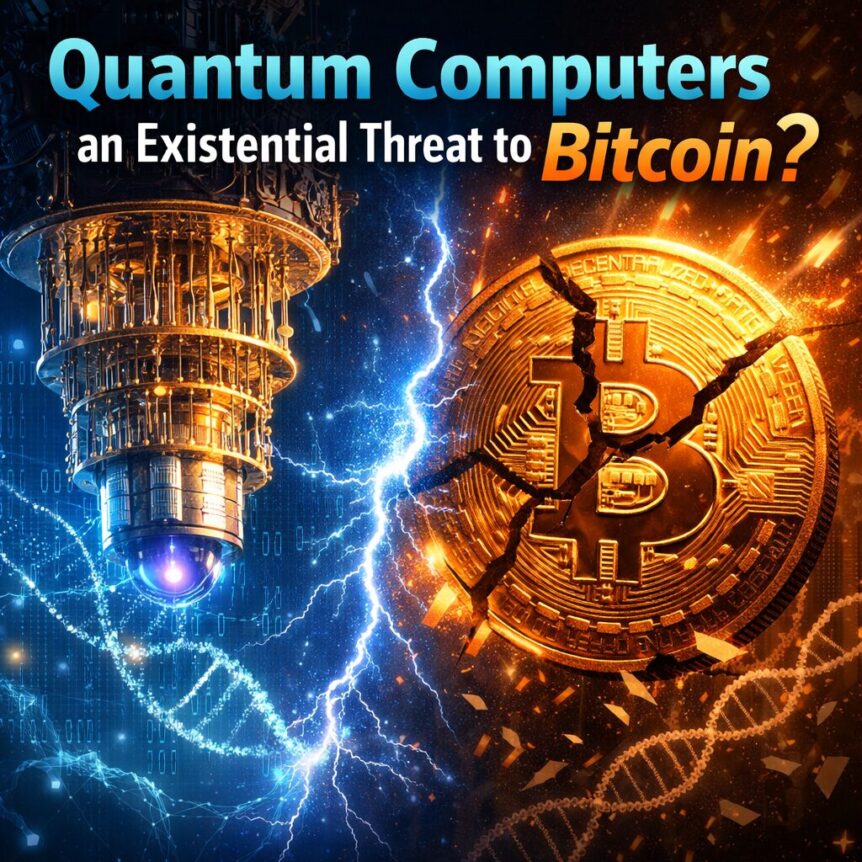
However, quantum computing’s rapid progress has triggered cybersecurity concerns, with experts warning of an impending threat to current encryption standards. The threat is especially pressing to the long-term security of Bitcoin, with several experts urging the broader crypto industry to prepare for the quantum threat.
How Do Quantum Computers Work
Quantum computers use quantum bits, also called qubits, that can express multiple values simultaneously. Qubits can also hold information influenced by another, even when separated by long distances. This is due to “quantum entanglement.” Qubits are not your regular computer bits. A regular bit can be 0 or 1. There isn’t any great mystery about them. A qubit is vastly different, thanks to a property called superposition. Because of this property, a qubit can be 0,1, or both simultaneously until it is actually measured, forcing it to choose a definite state. The coin analogy is the perfect way to explain this. A coin spinning in the air can be either “heads” or “tails” until it lands, after which it must be one of “heads” or “tails.” When two qubits are entangled, they become a single quantum system, no matter the physical distance between them.
The Threat to Bitcoin
Rapid advances in quantum computing have led experts to question the long-term security of systems relying on cryptography, including cryptocurrencies like Bitcoin. This is because the design of such systems, including Bitcoin, is based on mathematical assumptions about the limits of computational power.
There is little doubt that quantum computers will eventually be able to break the mathematical difficulty underpinning current cryptography. Unsurprisingly, this has compounded concerns around the present-day security of Bitcoin.
The concerns primarily involve Shor’s Algorithm, a quantum algorithm that can break the digital signature scheme (ECDSA) used by Bitcoin to prove the ownership of funds. Currently, it is nearly impossible to derive a private key from a public key with the available computational power. However, large-scale quantum computers could allow malicious entities to recover private keys from public keys in a relatively short duration and move the funds without the holder’s consent.
Around 25% of all Bitcoins are stored in vulnerable addresses, primarily Pay-to-Public-Key (P2PK) and Pay-to-Public-Key Hash (P2PKH) addresses. The former also includes Bitcoin creator Satoshi Nakamoto’s 1.1 million BTC. But what makes these addresses vulnerable? The addresses are vulnerable because they are visible on the blockchain, making them vulnerable to quantum attacks. A successful attempt to move coins out of these vulnerable addresses could create an unprecedented supply shock, severely undermining Bitcoin and putting substantial pressure on its price. Before moving ahead, I must stress that P2PKH addresses are vulnerable only after they have spent funds and the key has been publicly revealed on-chain. P2PKH addresses with no prior transactions are considered safer.
Another theoretical risk involves mempool transactions. In such a scenario, powerful quantum computers could observe mempool transactions before they are confirmed, derive the private key associated with the transaction, and broadcast a competing transaction that redirects funds before the original transaction is completed. Quantum computing could also jeopardize Bitcoin’s trust and privacy. Quantum-ready miners could gain a significant advantage in Proof-of-Work mining, leading to even more centralization. Centralization risks one single miner gaining enough control to censor transactions and reorganize blocks, significantly undermining Bitcoin’s decentralized network.
Malicious actors can also collect blockchain data with the expectation that quantum computers could decrypt it in the future. This could expose the identity of wallet holders, revealing information about prior transactions.
Bitcoin Remains Resilient
Experts have already started warning the Bitcoin and crypto community to enhance blockchain security before quantum computers become an imminent threat. The latest warning comes from Google and states that quantum computers could steal Bitcoin during active transactions. However, experts have downplayed the warning, stating that while the risk was real, it was not immediate.
Bitcoin uses the Elliptic Curve Cryptography (ECC) to generate public and private keys. ECC uses ECDSA signatures to verify transactions. Quantum computers could compromise this system, putting Bitcoin’s security at risk.
There are ways to mitigate the impending threat. The Bitcoin blockchain could adopt post-quantum cryptography (PQC) to ensure quantum-proof security. Post-quantum cryptography can be implemented gradually to replace vulnerable algorithms first, instead of uprooting the entire system by introducing a three-layer defense: Kyber, Dilithium, and SPHINCS+.
- Kyber – Secures communication between nodes and wallets, nullifying the risk of interceptions.
- Dilithium – verifies transactions, protects private keys from quantum attacks.
- SPHINCS+ – Ensures the integrity of transaction records.
The first “Bitcoin Quantum” testnets are already experimenting with NIST-standardized PQC algorithms, testing upgrades before they can be deployed to the main network. NIST-standardized post-quantum cryptography will preserve Bitcoin’s safety and integrity in the post-quantum computing era. Bitcoin’s decentralization also makes it highly resilient, removing any single point of failure. It’s fixed supply counters inflation, while its Proof-of-Work system makes large-scale attacks on the network costly.
The flagship cryptocurrency has seen unprecedented institutional interest through hedge funds, pension funds, and ETFs. However, its exposure to the global financial system makes it a prime target for malicious actors. Any attack that destabilizes Bitcoin could have global ramifications, and stakeholders must ensure long-term stability. Some industry experts have proposed transitioning to quantum-resistant addresses, a move that could have a substantial impact on Bitcoin’s market dynamics by locking away any Bitcoin held in old addresses, rendering them inaccessible. Moving to quantum-resistant addresses could remove millions of Bitcoin from circulation, leading to a supply shock and greater scarcity.
BIP-360: The Community Solution
Bitcoin developers have published BIP 360 to reduce Bitcoin’s quantum exposure. The soft fork introduces Pay-to-Merkle Root (P2MR), which enhances Bitcoin’s quantum resistance by introducing an output type that eliminates the on-chain exposure of public keys. Instead, it commits to the Merkle root of a script tree and requires users to use scripts instead of key-path spending. P2MR hides the public key by hashing the Merkle root directly into the output, eliminating the key path.
This means there is less cryptographic data visible on-chain, and public keys remain invisible for longer. While BIP-360 does not make Bitcoin immune to the quantum threat, it makes targeting the Bitcoin network more difficult by significantly reducing its exposure.
BIP-360 could fundamentally alter how Bitcoin outputs are created, spent, and secured. However, it is not a drastic overhaul, and old unspent transaction outputs will remain vulnerable. Users will have to manually move funds to P2MR outputs. Additionally, BIP-360 is not a replacement for ECDSA or Schnorr. The soft fork only addresses the Taproot key path exposure.
Conclusion
Transitioning to post-quantum cryptography will be time-consuming, and experts are urging the Bitcoin community to act immediately. The quantum threat extends beyond Bitcoin, with many digital systems and internet communication systems vulnerable. However, the consensus is that quantum computers that could potentially threaten Bitcoin are still a decade away, giving the community time to prepare. The window to act remains open, but won’t for too long.