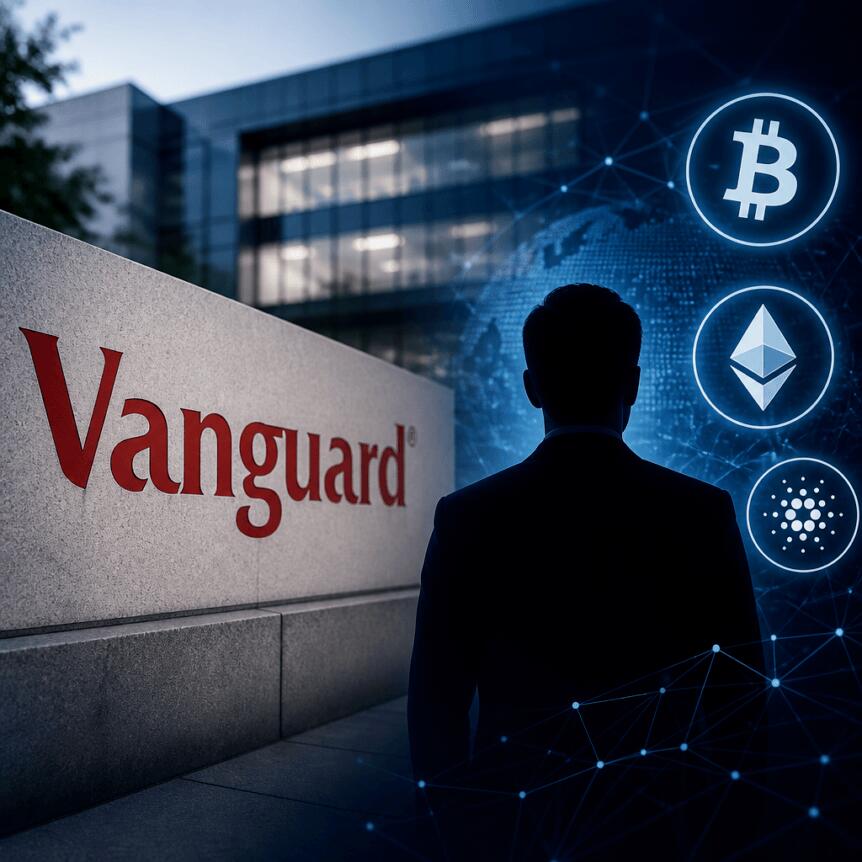
Vanguard has posted a new role aimed squarely at digital-asset strategy, appointing a “head of digital assets” to shape how the asset manager approaches tokenization, stablecoins, blockchain infrastructure, and client-facing crypto-related products. The hiring signal suggests a shift from Vanguard’s historically cautious stance toward direct crypto investment offerings.
In the job description, Vanguard says the person in the role will be responsible for determining how the firm participates in digital assets—covering everything from product evaluation and tokenization initiatives to custody models, blockchain settlement considerations, and the “digital asset operating infrastructure” needed to support such efforts. The role is also expected to represent Vanguard in discussions with regulators, clients, and industry groups.
Key takeaways
- Vanguard is hiring a “head of digital assets,” with explicit responsibilities across tokenization, stablecoins, custody, and blockchain-based settlement.
- The position includes a regulatory-facing component, indicating the effort is not limited to product experimentation.
- Vanguard’s hiring marks a notable contrast with prior statements rejecting certain crypto investment products, including crypto ETFs.
- Tokenized real-world asset (RWA) growth—and tokenized Treasuries in particular—continues to pull major asset managers deeper into the sector.
A broader digital-asset mandate than simple product testing
The posting lays out a comprehensive remit that goes beyond whether Vanguard will offer a specific token or investment product. According to the role description published on Vanguard’s jobs site, the new executive will evaluate “client-facing products” and consider how Vanguard might engage through multiple layers of the digital-asset stack—tokenization, stablecoins, custody model design, settlement workflows, and operational infrastructure.
That breadth matters for investors and counterparties because it implies Vanguard is working toward a sustained capability rather than a short-lived pilot. When firms focus only on distribution, they can remain reactive. By contrast, a mandate that includes custody and settlement suggests Vanguard may be aligning internal processes with how digital assets are issued, secured, and moved—an important prerequisite for scaling any future offerings.
The job also indicates that the role will serve as a bridge between the business side and external stakeholders, with responsibility for Vanguard’s participation in regulator, client, and industry discussions. That kind of engagement is often overlooked in public narratives around crypto adoption, but it typically determines whether products can move from concept to compliance-ready execution.
From resistance to reconsideration
Vanguard’s move is particularly striking given its earlier public posture toward crypto. In August 2024, then-CEO Salim Ramji said Vanguard would not launch crypto exchange-traded funds, arguing the firm would not “copy competitors” despite the rapid adoption of spot Bitcoin ETFs across the market.
More recently, ETF analyst Nate Geraci pointed out the practical contradiction: Vanguard had previously blocked customers from purchasing spot Bitcoin and Ether ETFs through its brokerage platform. Geraci highlighted the shift in an X post on Tuesday, adding “Life moves pretty fast,” underscoring how quickly the firm’s posture appears to be evolving.
Neither the hiring description nor the article’s details clarify whether Vanguard will immediately launch any particular crypto product. However, the existence of a role spanning tokenization, stablecoins, custody, and settlement suggests the company is now building decision-making capacity that could support new offerings—potentially including products investors could access in the future.
Why tokenization is pulling asset managers in
Vanguard’s hiring arrives as major asset managers expand their involvement in tokenized finance. Data compiled by RWA.xyz indicates the tokenized real-world asset market has grown to $33.5 billion. Within that figure, tokenized U.S. Treasury products account for $14.9 billion—an area that has drawn particular attention because it connects tokenized exposure to government debt instruments.
RWA.xyz data also points to the scale of major players in tokenized Treasuries: Franklin Templeton manages about $2.5 billion in tokenized assets, BlackRock oversees roughly $2.3 billion, and WisdomTree’s tokenized Treasury fund has grown to more than $700 million.
These figures help explain why tokenization is becoming a strategic priority rather than a niche experiment. Tokenized Treasury products are frequently positioned as an entry point for institutions that want blockchain settlement benefits—such as faster movement of value or improved interoperability—while maintaining exposure linked to established benchmarks.
Competition accelerates across tokenized cash, liquidity, and ETFs
The broader industry context includes multiple initiatives from large financial firms aiming to integrate tokenization and digital settlement. In March, Franklin Templeton partnered with Ondo Finance to offer tokenized versions of its ETFs accessible through crypto wallets, according to coverage referenced in the source material. Later, Franklin Templeton launched a dedicated cryptocurrency investment division after its acquisition of crypto asset manager 250 Digital.
Other large institutions have pursued tokenized cash and liquidity products as well. JPMorgan filed in May to launch a tokenized money market fund for stablecoin issuers. State Street introduced a government money market fund for stablecoin reserves and a tokenized liquidity product the following month.
Fidelity also moved into blockchain-based liquidity. The source material notes that Fidelity launched a blockchain-based liquidity fund in May, and that it received its first crypto-native investment after Theo allocated $20 million to the product.
Taken together, these developments highlight a sector pattern: many incumbents appear to be approaching crypto-related infrastructure through tokenized cash, liquidity, and Treasury instruments first—areas where regulators and compliance teams may find more familiar analogues than, say, direct exposure to volatile crypto assets.
For Vanguard, the job description’s emphasis on custody models, settlement mechanisms, and operating infrastructure aligns with this market direction. If tokenized cash and Treasury products keep growing, the firms that can support secure issuance, operational workflow, and compliance will likely be best positioned to expand product ranges over time.
Investors and industry watchers should monitor whether Vanguard’s digital-asset hiring translates into concrete offerings—particularly around tokenization and custody—or whether the early phase remains focused on internal buildout and regulatory engagement. The key open question is what form Vanguard’s participation will take next, and how quickly the firm moves from strategy to investor-accessible products.