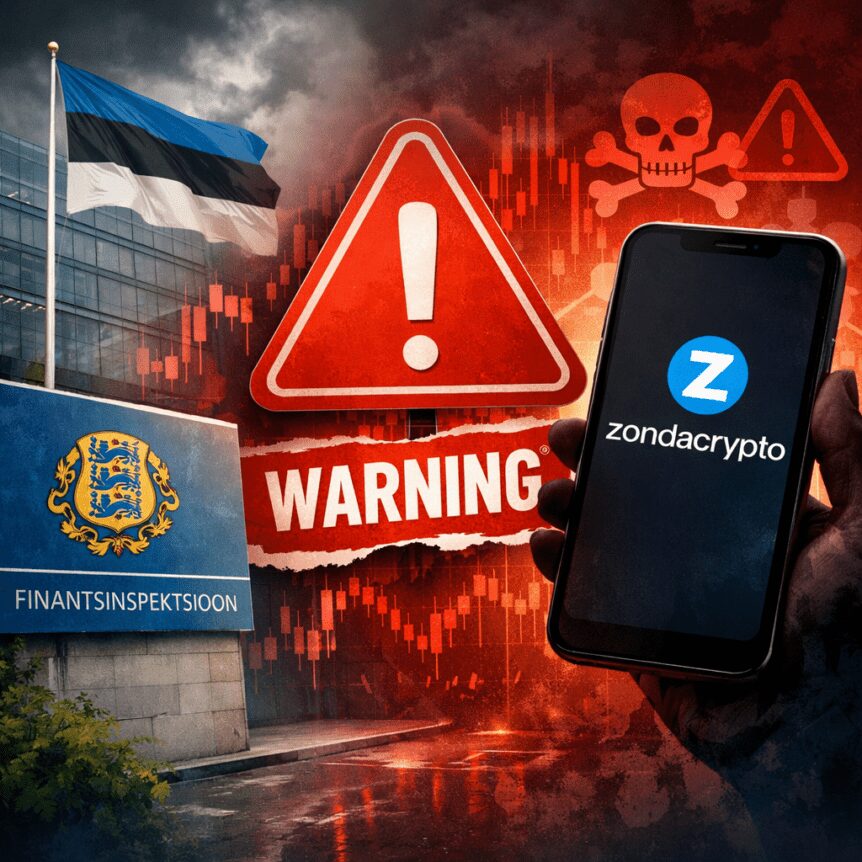
Estonia’s financial regulator has issued an investor warning against BB Trade Estonia OÜ, the operator behind the Zondacrypto digital asset exchange, citing a missing white paper for the TeamPL token. The Financial Supervisory and Resolution Authority (FSA) says the absence of a published white paper on the exchange’s site violates the EU’s Markets in Crypto-Assets (MiCA) framework, which requires ongoing disclosure for crypto assets offered to the public.
According to the FSA, the warning rests on Article 9, Section 1 of MiCA, which obligates issuers and those seeking admission to trading to keep crypto-asset white papers available on their websites for as long as the assets are held by the public. The FSA’s action signals renewed EU-wide emphasis on disclosure and investor protection as MiCA preparations unfold for a broader set of firms, including smaller exchanges operating across member states.
Cointelegraph reached out to Zondacrypto for comment by publication time but did not receive a response. The warning arrives as Zondacrypto has faced a string of operational and regulatory headwinds, including withdrawal difficulties that have prompted law-enforcement scrutiny in Poland.
The regulatory development comes amid elevated attention to MiCA’s impact on smaller crypto firms, a topic Cointelegraph has previously explored in the context of Europe’s evolving regime for crypto assets and market participants.
The investor warning for Zondacrypto and its parent company. Source: Estonia FSA
In April, Polish authorities opened an investigation into Zonda/ Zondacrypto after users reported withdrawal problems and difficulties accessing their funds. The case has layered regulatory scrutiny across jurisdictions, underscoring cross-border enforcement challenges in a MiCA-enabled Europe.
Related: Europe’s MiCA regime puts smaller crypto firms under pressure
Key takeaways
- The Estonian regulator issued an investor warning to BB Trade Estonia OÜ for lacking a publicly available white paper for the TeamPL token, invoking MiCA Article 9(1).
- The action highlights MiCA’s ongoing disclosure obligations and the heightened regulatory risk for EU-based exchanges and issuers.
- The warning follows withdrawal issues at Zondacrypto and a Polish law-enforcement probe, illustrating cross-border regulatory risk and enforcement coordination within the EU and its neighborhood.
- Company leadership has presented competing narratives about operational solvency and control of key crypto assets, amid questions over governance and long-standing management challenges.
- The case underscores broader MiCA implications for smaller firms, licensing considerations, AML/KYC obligations, and the evolving cross-border regulatory framework in Europe.
Zondacrypto under heightened regulatory and operational scrutiny
Estonia’s FSA stated that BB Trade Estonia OÜ operates Zondacrypto, and the regulator’s warning focuses on the absence of a white paper for the TeamPL token. The FSA asserted that the white paper must remain accessible on the issuer’s site for as long as the token is publicly held, reflecting MiCA’s emphasis on investor protection through transparent disclosures. The regulator’s document links to MiCA’s requirement for ongoing disclosure and reinforces the supervisory stance that even smaller platforms must maintain accessible documentation to inform investors and potential participants.
The FSA’s action comes amid broader questions about how MiCA will reshape the behavior and governance of crypto platforms with EU-based market access. As the European regime continues to take shape, regulators across member states are scrutinizing compliance practices that affect marketing, issuance, and trading of crypto assets. The exact regulatory consequences for BB Trade Estonia OÜ remain to be seen, but the warning could carry potential remedial demands, enforcement action, or other supervisory measures if non-compliance persists.
Withdrawal turmoil, governance questions, and cross-border investigations
Separately, Zondacrypto’s governance and asset-access issues have attracted attention from Polish authorities. In April, Przemysław Kral, the company’s CEO, publicly claimed that the exchange did not have access to a cold wallet containing approximately 4,500 BTC, valued at hundreds of millions of dollars at the time. Kral attributed the problem to a failure to obtain private keys from Sylwester Suszek, the founder and former chief executive, who has reportedly been missing since 2022. While Kral denied insolvency, he asserted that customer obligations would be met, notwithstanding the ongoing access problems.
Subsequent reporting indicated that Kral ceased posting on X in mid-April, and local media suggested he relocated to Israel amid the Polish investigation. Earlier in February, Kral had described Zondacrypto as a Polish-rooted enterprise operating outside Poland’s borders to align with MiCA standards, signaling strategic considerations about where the firm can legally and operationally function within the EU’s regulatory perimeter.
Polish investigators began examining the exchange after users reported withdrawal issues and concerns about accessing funds. The development illustrates how cross-border enforcement and regulatory differences—MiCA implementation in the EU versus national crypto rules in non-EU states—can complicate enforcement, asset recovery, and investor protection when platforms encounter liquidity or custody challenges.
These dynamics place additional pressure on firms to maintain robust custody arrangements, formalized governance structures, and transparent disclosures, particularly as authorities increasingly view cross-border operations through a MiCA-centric lens. The situation also emphasizes the need for clear procedures around loss of keys, governance handovers, and communications with customers during periods of stress, given the potential investor impact and regulatory scrutiny.
Broader policy context and implications for market participants
Analysts monitoring the case note that MiCA is designed to harmonize disclosure standards and supervisory expectations across the European Union, potentially compelling smaller actors to shore up compliance, licensing, and risk management frameworks. The Estonia FSA’s action is consistent with a broader regulatory push to ensure that investors can access critical information about crypto assets offered to the public and traded on EU platforms. In parallel, authorities in Poland and other jurisdictions demonstrate that enforcement will continue to traverse borders, requiring cooperation and information-sharing to address operational failures, custody risks, and potential misappropriation concerns.
For exchanges seeking to operate under MiCA, the case underscores several practical implications: maintaining up-to-date white papers and disclosures; ensuring custody arrangements are verifiable and resilient; and maintaining clear lines of communication with customers and regulators. It also highlights the enduring tension between national regulatory regimes and EU-wide directives, particularly for entities with roots in one jurisdiction but active service across multiple member states.
From a compliance perspective, the episode reinforces the importance of AML/KYC frameworks, licensing status, and ongoing regulatory reporting. For investors and institutional clients, the development serves as a reminder to assess counterparty risk, governance quality, asset custody arrangements, and the credibility of information disclosed by platforms operating within or outside EU borders.
Looking ahead, authorities may pursue further clarifications, corrective actions, or sanctions related to the MiCA-compliance shortfall identified by the Estonian regulator. The cross-border nature of Zondacrypto’s challenges—combining MiCA obligations with Polish enforcement activity—will likely keep regulators attentive to lessons learned about transparency, custody risk, and the resilience of digital-asset trading platforms in the EU ecosystem.
Closing perspective: As MiCA continues to shape regulatory expectations for crypto firms, the Zondacrypto case illustrates how disclosure requirements, governance standards, and cross-border investigations intertwine to influence operational viability and investor protection in Europe’s evolving crypto market.