<Iran’s internet restrictions have not derailed a single financial lifeline for the country: Nobitex, a Tehran-rooted cryptocurrency exchange, continues to operate and process large volumes even as analysts describe a tightly controlled domestic crypto ecosystem. New data from analytics firms and investigative reporting depict Nobitex as both a retail gateway for ordinary Iranians and a potential fulcrum for sanctions evasion and state-led finance.
Estimates of Nobitex’s scale vary, but multiple firms place its activity in the billions of dollars. TRM Labs, for instance, reported approximately $5 billion in observed volume on Nobitex between 2025 and March 2026. Chainalysis has previously noted that inflows to Nobitex addresses exceeded the combined inflows of Iran’s next ten largest exchanges, underscoring the platform’s outsized role in the domestic crypto economy. Nobitex’s own disclosures say it serves around 11 million Iranians, about 12% of the population, with a broad suite of services that extends beyond spot trading to margins, yield products, liquidity pools, gift cards, and crypto-collateralized lending. The platform also provides differentiated terms for professional and institutional participants.
Key takeaways
- Nobitex processes billions in value and claims a retail footprint of roughly 11 million users, making it a linchpin of Iran’s crypto activity despite a broader online isolation.
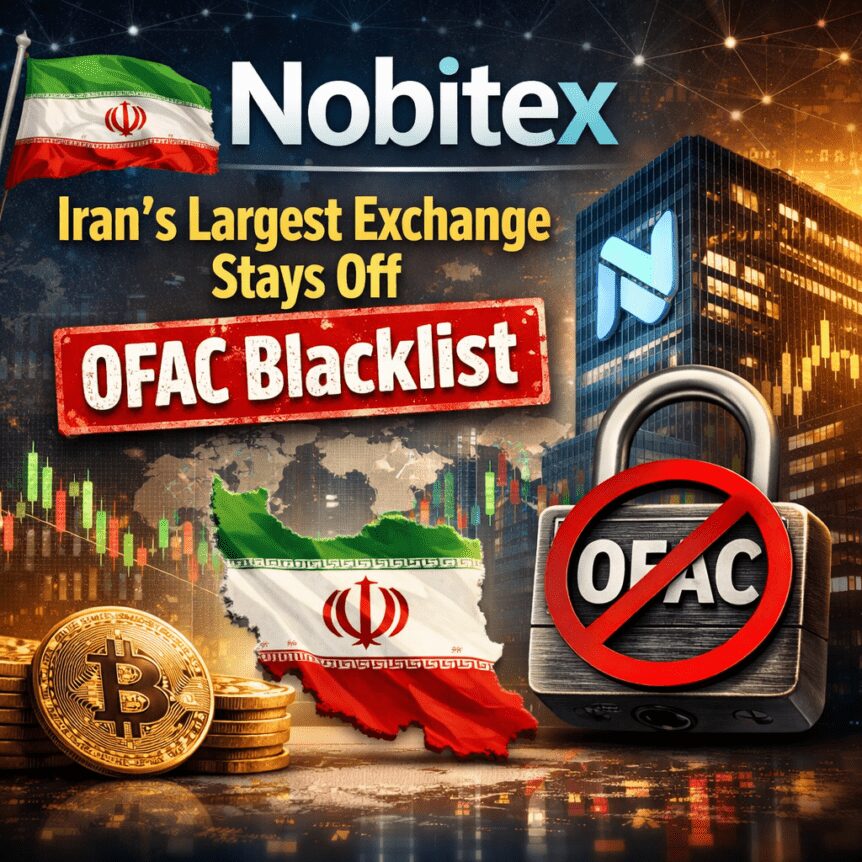
- Regulators have not sanctioned Nobitex on the U.S. Treasury’s Specially Designated Nationals (SDN) List, but authorities have long treated Iranian crypto exchanges as blocked financial institutions, complicating enforcement and international participation.
- Investigations and disclosures link Nobitex to state-driven usage, including central-bank activity in stablecoins and ties to elite networks, prompting questions about where sanctions pressure is most effective.
- Analysts warn that the Nobitex case highlights a larger tension: sanctions aim at deterring regime finance, but may also entangle millions of ordinary users who rely on crypto for access to foreign liquidity and inflation resilience.
Nobis footprint: retail gateway and strategic asset channel
Beyond its consumer-facing services, Nobitex has developed an architecture that some observers describe as purpose-built to operate under sanctions. Its platform accommodates a broad retail audience, while its API and service tiers cater to high-volume traders and institutions seeking faster settlement and higher limits. This combination makes Nobitex more than a passive conduit; it acts as a central node where ordinary users and sanctioned-related flows intersect.
In parallel, broader market research situates Nobitex as a critical domestic hub. The exchange’s scale aligns with a larger pattern identified by researchers: Iran’s crypto environment has matured from experimental use into a structured ecosystem that blends retail adoption with state-driven financial choreography. As Chainalysis has emphasized, Iran’s crypto model—mass retail, external-facing gateways, and offshore intermediaries—has evolved into infrastructure that regulators must increasingly reckon with.
Sanctions architecture and the state’s use of Nobitex
Several investigations have sketched out how Nobitex intersects with sanctions policy and external finance. In January 2026, Elliptic published a report detailing systematic purchases of the U.S. dollar-pegged stablecoin USDT by Iran’s central bank. The firm documented at least $507 million in such purchases conducted through a UAE broker, with assets reportedly routed to Nobitex and converted into Iranian rial liquidity. The arrangement suggests an end-run around conventional foreign-exchange channels, leveraging stablecoins to inject dollars into the domestic economy through a sanctioned intermediary.
Separately, Reuters traced Nobitex back to influential Iranian families, including the Kharrazi clan, and noted that one of the early Nobitex investors was Mohammad Baqer Nahvi, a former official tied to Safiran Airport Services and placed on the OFAC SDN List in 2022 for facilitating drone-related shipments. These connections fuel scrutiny of Nobitex as more than a market operator; for some observers, the platform sits at the intersection of political power and financial access.
The platform has also attracted attention for its technical and compliance footprint. Leaked materials in 2025 suggested Nobitex’s internal code contained modules intended to bolster stealth transactions, endpoint switching, and compliance evasion. A document titled “Nobitex Privacy” outlined strategies aimed at evading U.S. FinCEN and Western blockchain-analytics tools. Such material reinforces perceptions that Nobitex was engineered—at least in some respects—to function under sanctions-era constraints.
And the public record of sanctions enforcement adds nuance to Nobitex’s status. The U.S. Treasury has sanctioned Iran-linked exchanges in the past, including instances where platforms operated from overseas. Yet Nobitex is incorporated in Iran, and its core user base resides there, complicating the enforcement calculus. OFAC has clarified that Iranian digital asset exchanges are treated as blocked financial institutions irrespective of individual SDN designation, a stance that carries significant implications for any foreign counterparties seeking to transact or list Iranian-driven assets.
The broader enforcement framework is not limited to named entities. OFAC’s published FAQs note that sanctions goals can be achieved through targeting specific addresses, designating exchange houses, or naming individuals and OTC brokers. The result is a multidimensional approach where a domestic exchange can be affected not only by direct restrictions but also by the risk posture of foreign banks, stablecoin issuers, and other transactional intermediaries. In Nobitex’s case, some observers argue that a formal SDN listing may offer limited incremental leverage beyond existing restrictions, given that U.S. persons are already prohibited from transacting with Iranian exchanges.
Analysts also consider the human element in sanctions design. Crystal Intelligence’s Nick Smart argues that Nobitex’s user base is heavily concentrated among ordinary Iranians, complicating the decision to isolate the regime from its citizens. This “human shield” concern mirrors broader debates about the social impact of asset freezes, and it contrasts with cases like Garantex—another exchange with a different operational profile that allowed authorities to seize servers with less collateral impact on retail users.
What this means for policy, markets, and the road ahead
The Nobitex narrative sits at a nexus of three ongoing dynamics in crypto regulation and geopolitics. First, sanctions policy is moving from targeting isolated entities to shaping entire market structures. The industry’s experience in Iran, Russia, North Korea, and other jurisdictions shows that what began as experimental financial maneuvers have matured into state-aligned economic strategies. Chainalysis has described this shift as a pattern of institutionalization, not just episodic enforcement.
Second, the question of how best to apply pressure remains unsettled. Isolating a local platform through a targeted SDN listing the most effective means to choke off “exits” like stablecoins and cross-border flows, or would broader action against offshore intermediaries be more impactful? The answer may depend on the ability of regulators to coordinate with foreign entities and on whether a platform like Nobitex is treated as a domestic utility or as a strategic choke point for external finance.
Finally, the Nobitex case underscores a practical tension for investors and builders in crypto markets: sanctions-driven adoption, resilience, and risk. For users inside Iran, crypto provides a degree of inflation protection and external liquidity, but the same infrastructure can be repurposed for currency interventions and regional proxy transfers. For international participants, the case highlights the importance of robust due diligence, counterparty risk assessment, and compliance frameworks when engaging with platforms tied to politically sensitive jurisdictions.
Looking ahead, observers will watch how U.S. policymakers recalibrate their approach to Iranian crypto markets. Will the authorities move to extend SDN designations to newly prominent platforms, or will they sharpen enforcement around exits and stablecoin flows to minimize collateral damage to ordinary users? The answer could shape not only Nobitex’s trajectory but the broader balance between sanctions efficacy and the unintended consequences for millions of ordinary Iranians who rely on crypto for access to global liquidity.
As regulators and market participants digest these developments, the central question remains: where does the line lie between pressuring regime finance and preserving the financial agency of everyday users? The answer will unfold in the next rounds of sanctions policy, enforcement actions, and the evolving architecture of Iran’s crypto economy.